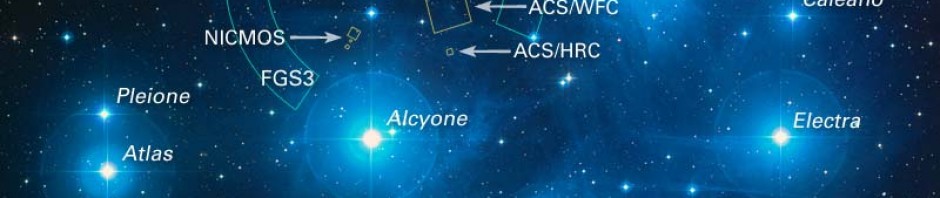
To make these definitions practical and useful, Everyday Spacer style, these are simple explanations for sometimes quite complicated terms. If you have a better explanation, please send a message to Pam at Everyday Spacer dot com. We’ll update accordingly. Thank you!
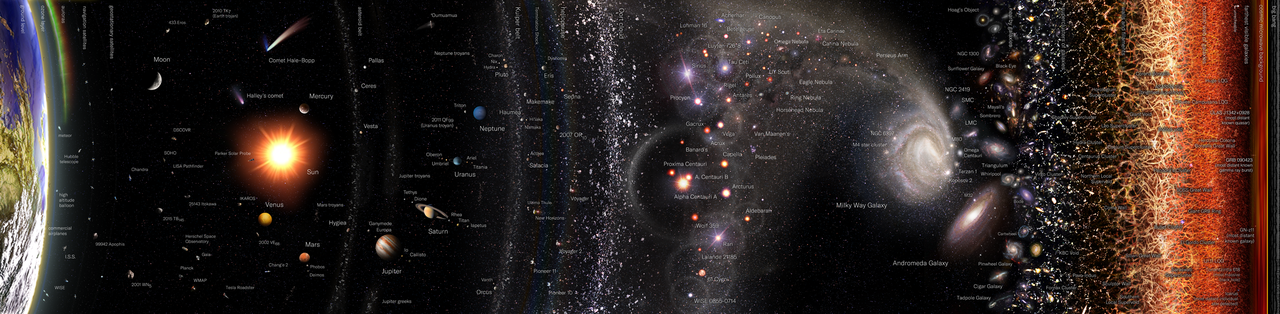
Observable Universe Logarithmic Map By Pablo Carlos Budassi – Own work, CC BY-SA 4.0, https://commons.wikimedia.org/w/index.php?curid=74584660
Annular Eclipse: an eclipse of the Sun which does not block the entire object – the Moon is further out and the light from the Sun looks like a skinny donut
Apogee: when an object in orbit – like the Moon around the Earth – is the most distant from the object it is orbiting
Ascending Node:
Asterism:
Baily’s Beads: the “arc of bright spots seen during total and annular eclipses of the Sun. They are named for Francis Baily, an English astronomer, who called attention to them after seeing them during an annular eclipse on May 15, 1836. Just before the Moon’s disk covers the Sun, the narrow crescent of sunlight may be broken in several places by irregularities (mountains and valleys) on the edge of the Moon’s disk; the resulting array of spots roughly resembles a string of beads.” [see also Sources, below]
Bolide:
Brown Dwarfs:
Conjunction: usually refers to two celestial bodies within one degree of each other visually – they may actually be much more distant in reality
Corona:
Constellations: (of stars)
Descending Node:
Exo-planets:
Full Moon: the appearance of the part of the globe of the Moon fully lit and reflecting the light from the Sun, as seen from Earth
Galaxies:
Galaxy Groups and Clusters:
Greatest Eastern Elongation:
Greatest Western Elongation:
Lunar Eclipse:
Nebulae:
New Moon: when the Moon is between the Sun and the Earth and it can’t actually be seen from Earth because the side facing Earth is in shadow
Opposition: usually refers to a planet in the solar system on the opposite side of the Earth from the Sun – could be any two astronomical objects though – and tends to be the best time to view and photograph planets like Saturn
Path of Totality: when looking for a Total Solar Eclipse, the path on the Earth where to best, longest view of the Eclipse may be seen
Perigee: when an object in orbit – like the Moon around the Earth – is the closest to the object it is orbiting
Planetary Trio: “By definition, a planetary trio consists of three planets fitting within a circle whose diameter is less than 5 degrees in width. For reference, three fingers held together at an arm length approximates 5 degrees. Given that a typical binocular field of view spans 5 degrees or more, binoculars come in super handy for viewing a planetary trio. If you spot Jupiter with the eye alone, but not Mercury or Saturn, aim binoculars at Jupiter to see the threesome taking stage in a single binocular field!”
Found here January 2021…https://earthsky.org/tonight/planetary-trio-low-in-west-at-dusk?utm_source=EarthSky+News&utm_campaign=b662175efa-EMAIL_CAMPAIGN_2018_02_02_COPY_01&utm_medium=email&utm_term=0_c643945d79-b662175efa-393565217
Solar System: a term describing the system of the Sun and objects in orbit like Mercury, Venus, Earth, Mars, Jupiter, Saturn, Uranus, Pluto and the other objects in this range and influenced by the gravity of the other objects in the system
Solstice: there is one in June and one in December – it’s when the Sun reaches it highest position in the sky and will be directly over one of the ‘tropics’ (Tropic of Cancer in the North and Tropic of Capricorn in the South) which defines the first day of the new season switching to Summer or Winter and depending on which hemisphere of Earth you are on
Star Party: the gathering of amateur astronomers and others for the purpose of observing the night sky naked eye, with binoculars and with telescopes – the only ‘party’ you are encouraged to crash
Stars:
Star Clusters:
Summer Solstice:
Sun, the: the star nearest Earth
Total Solar Eclipse: a beautiful phenomenon viewed from Earth of the Sun with the Moon blocking the light from the Sun
This page is a work in progress, possibly forever, as we learn new terms and make them as easy to use as possible. Thank you for visiting! :)
Sources…
http://www.seasky.org/astronomy/astronomy-calendar-2019.html
https://en.wikipedia.org/wiki/Opposition_(astronomy)
https://www.britannica.com/science/Bailys-beads